


Published on March 23, 2026
 As organisations navigate AI acceleration, workforce shifts and growing operational complexity, knowledge is increasingly emerging as a strategic capability that shapes how quickly they learn, adapt and make decisions.
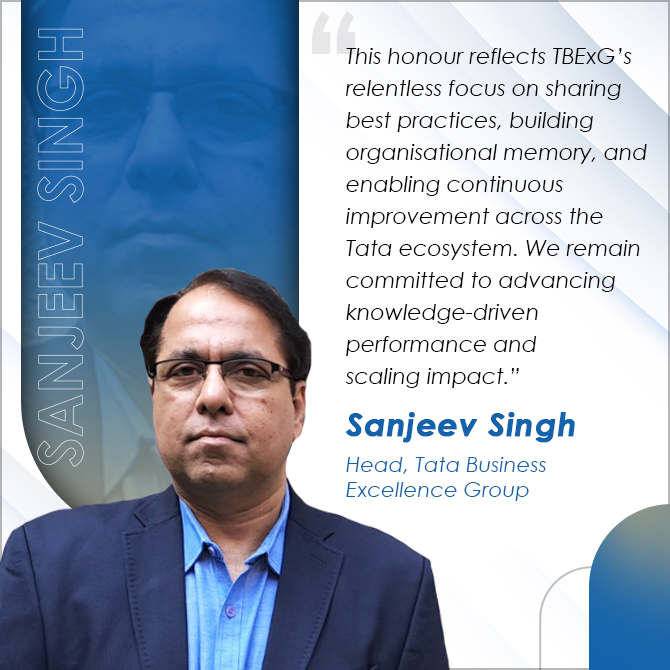
Recognising organisations that have successfully embedded knowledge practices into everyday work, APQC has named Tata Business Excellence Group (TBExG) among the 2026 recipients of the Excellence in Knowledge Management recognition at the enterprise level.
The recognition places TBExG among a global cohort of organisations demonstrating strong capabilities in capturing, sharing and applying knowledge to drive measurable business value. Other enterprise-level recipients this year include Cognizant Technology Solutions, Dubai Municipality, North Highland and Mercer.
When Knowledge Becomes a Strategic Capability
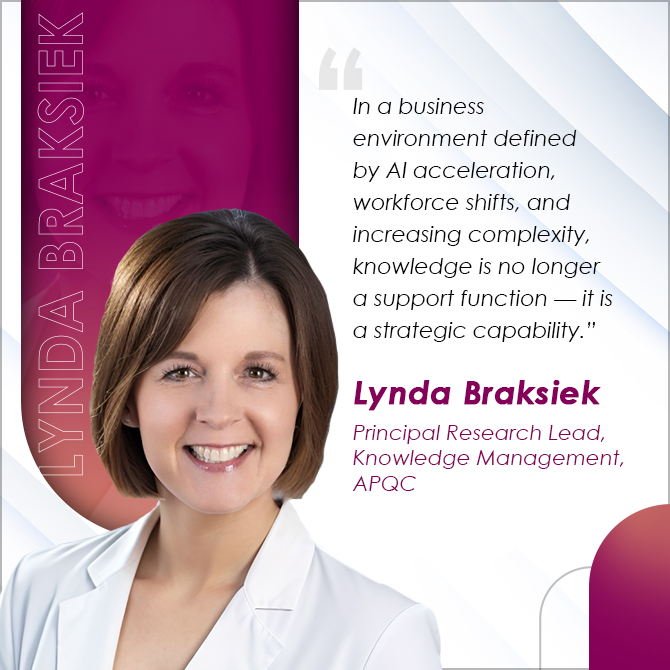
The APQC recognition reflects a broader shift in how organisations view knowledge management.
Organisations recognised this year, Lynda noted, are operationalising knowledge to reduce risk, accelerate learning, and strengthen innovation outcomes.
Increasingly, the value of knowledge lies not only in storing information but in ensuring that insights, expertise and experience flow across the organisation, helping teams learn faster, improve decisions and scale best practices.
Measuring the Maturity of Knowledge Systems
APQC’s Excellence in Knowledge Management recognition is grounded in the Knowledge Management Capability Assessment Tool (KMCAT), a structured methodology used by organisations worldwide to evaluate the strength of their knowledge practices.
The framework assesses organisations across four categories: strategy, people, process, and content and information technology. The assessment also draws on APQC’s Levels of Knowledge Management Maturity, a model designed to help organisations evaluate how deeply knowledge practices are embedded within their systems and decision-making processes.
According to APQC research, only a small proportion of organisations reach the most advanced stages of KM maturity, where knowledge practices are fully integrated with business performance and innovation outcomes.
How Mature KM Programmes Create Impact

Across industries, mature knowledge management programmes are enabling faster transfer of expertise across teams, improving collaboration across functions, strengthening retention of institutional knowledge, and supporting responsible adoption of emerging technologies such as AI.
Leading programmes, Cindy noted, are building dynamic knowledge environments where people networks, governance processes and technology work together to ensure knowledge is preserved and applied where it matters most.
A Global Benchmark for Knowledge Management
Since its launch in 2019, APQC’s Excellence in Knowledge Management recognition has highlighted organisations demonstrating mature and adaptive knowledge practices. Insights from these organisations inform APQC research, benchmarks and guidance for the global knowledge management community.
Enabling Knowledge Flow across the Tata group
The recognition reflects the broader role TBExG plays in enabling knowledge flow across the Tata group’s business excellence ecosystem.
Through Assessments, leadership programmes, learning forums and knowledge exchanges, TBExG helps Group companies capture and apply insights emerging from diverse industries and organisational contexts, enabling practices and lessons from one company to inform improvements across others.