
Published on April 29, 2026
As organisations operate in increasingly complex and fast-moving environments, Enterprise Risk Management (ERM) is shifting from a reporting requirement to a core business discipline today.
Cognisant of this, JLR has reimagined its ERM framework, drawing on Tata Power’s mature, system-led approach to risk and adopting several of its ERM practices. This was facilitated through an in-depth knowledge-sharing engagement hosted by Tata Business Excellence Group (TBExG) in 2025-26.
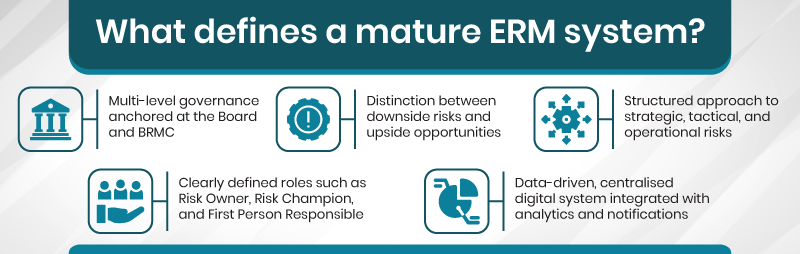
Tata Power’s Ketayun Kurosh Fallahzadeh, Head – Risk Management, Ethics & Compliance, and Rajesh Daga, Chief — Internal Audit & Risk Management, provided a comprehensive walkthrough of their company’s ERM framework, digital systems, and governance model at the knowledge-sharing session. This provided visibility to the JLR team on how Tata Power operationalises its end-to-end ERM system, including its in-house platform, governance structures, risk quantification, assurance mapping, and opportunity management. The session highlighted the core elements of Tata Power’s ERM system, including its defining aspect or clarity of ownership with risk accountability embedded across levels.
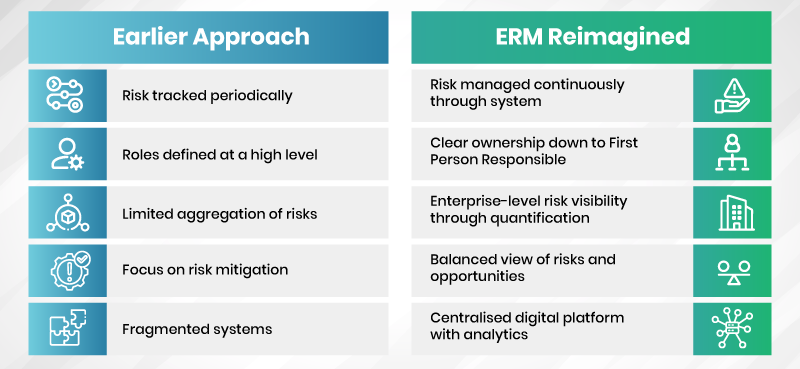
These insights have informed the design of JLR’s ERM Reimagined framework, where several of Tata Power’s practices have been adapted to its own business context.
1. System design
The walkthrough of Tata Power’s in-house risk management system informed the development of JLR’s ERM SharePoint system, enabling similar functionality and improved consistency across chapters.
2. Roles and responsibilities
Tata Power’s reporting structure — from the Board and BRMC to Cluster Committees and Business Units — and defined risk roles helped shape JLR’s approach to accountability.
JLR has now defined roles such as Risk Owner, Risk Champion, Risk Lead, and First Person Responsible (FPR), embedding accountability within the SharePoint system. The introduction of the FPR role strengthens day-to-day ownership of risk management.
Like Tata Power, JLR has also incorporated structured reviews of business units and subsidiaries with periodic engagements by Executive Directors strengthening alignment across the organisation.
3. Risk quantification
Tata Power’s method of quantifying risks based on financial value and aggregating them into enterprise-level profiles has helped JLR enhance the way it assesses and communicates risk exposure.
4. Risk types and opportunities
The distinction between downside risks (threats) and upside risks (opportunities) has influenced JLR’s evolving approach in the ERM Reimagined model. This introduces a more balanced view of risk, extending beyond mitigation to identifying potential value.
At Tata Power, opportunities are owned by the Business Development team and this approach has influenced JLR’s thinking on integrating opportunity management within its broader risk framework.
5. Risk classification and categories
Tata Power classifies risks at three levels: Strategic, Tactical, and Operational. Each level includes categories tailored to Tata Power’s business context (such as regulations, projects, technology, competition, environment, health & safety, human resources, and financials). While the categories differ by industry, the structured methodology has guided JLR in redesigning its own risk taxonomy.
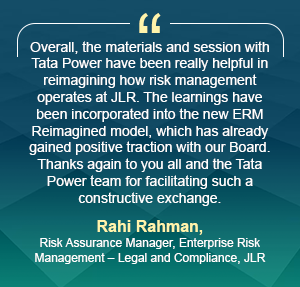
The impact of this knowledge-sharing effort has already been recognised at senior leadership levels within JLR. The enhanced ERM Reimagined model has received positive feedback from Executive Directors and the Board of Directors.
The collaboration reflects how practices evolve within the Tata group through shared learning and contextual adaptation. Rather than replicating frameworks, companies interpret and apply proven approaches to strengthen their own systems. In this case, Tata Power’s ERM maturity has helped shape a new model at JLR that connects risk more closely with accountability, decision-making, and business performance.