Published on November 06, 2026
The Voltas delegation interacted with senior leaders from Tata Motors, including Alok Dwivedi, General Manager - Press & BIW Operations; Vivek Deshmukh, General Manager -SCM; Amol Chincholikar, Deputy General Manager - SCM Warehousing; and Ramakrishnan K – Deputy General Manager, BIW Operations; who shared valuable insights across the SCM value chain.
The structured benchmarking exercise focused on supply-chain and manufacturing practices, particularly sheet-metal inward processes, material handling, stores management, shopfloor controls and vendor engagement. The visit also exposed the team to 5S, visual management, line feeding, line-side storage and daily work management practices.
During the visit, the Voltas team studied several operational practices, including standard trolleys and bins, unidirectional material flow, two-bin systems, stock rotation, stage-wise material release, zone-level monitoring, problem-solving through 5W1H and quality tools, and the display and use of standard operating procedures (SOPs) on the shopfloor.
Following the visit, Voltas CAC reviewed the practices in the context of its own workplace and implemented four key learnings:
- 5S practices on the shopfloor
- Visual management
- Kaizens for process optimisation
- Re-layout of identified areas to improve movement of people and materials
Implementation 1: Strengthening 5S on the Shopfloor
Voltas CAC strengthened the deployment of 5S in identified shopfloor and material-handling areas. The implementation focused on creating a more organised workplace, improving visibility and accessibility of required items, and bringing greater discipline to the arrangement of tools, materials and workspaces.
The practices observed at Tata Motors included unidirectional flow, two-bin arrangements and stock rotation as different mechanisms for maintaining orderly storage and material movement. These observations helped the Voltas team review how materials and frequently used items were positioned and controlled within its own operating areas.
As part of the implementation:
- Unnecessary items and obstructions were identified for removal from selected work areas.
- Locations were defined for tools, materials, bins and other frequently used items.
- Shopfloor spaces were organised to support easier identification and retrieval.
- Housekeeping expectations were reinforced to maintain orderly and obstruction-free working areas.
- The improved workplace arrangement was integrated with visual controls so that deviations could be identified more easily.
The implementation has created a stronger foundation for workplace discipline, better use of available space and safer, more efficient movement within the selected areas. It has also made abnormalities such as misplaced materials, excess inventory and blocked movement paths more visible for timely action.
Implementation 2: Introducing Visual Management
The visit demonstrated how visual management could make operational information immediately available to shopfloor employees and supervisors. Tata Motors used zone boards on production lines for monitoring by supervisors and teams, management reviews and the flow of operational information. The boards supported visibility of shopfloor parameters as well as structured problem-solving using 5W1H and other quality-control tools.
Drawing on this learning, Voltas CAC introduced and strengthened visual controls in identified areas. These controls were designed to communicate the expected condition of the workplace and enable employees to identify deviations without depending entirely on verbal instructions.
The implementation included:
- Identifying and marking designated storage and working locations
- Differentiating material-holding and movement areas visually
- Improving display of operating instructions and relevant shopfloor information
- Indicating clearly the correct location and status of materials, tools and bins
- Using visual cues to reinforce workplace organisation and facilitate routine monitoring
- Increasing visibility of abnormalities and improvement opportunities to operators and supervisors
Tata Motors’ practice of displaying and using SOPs on the shopfloor also reinforced the importance of making standard work readily visible where the activity is performed.
The visual-management implementation has therefore supported greater consistency in daily operations. It has reduced dependence on individual memory and made the expected workplace condition easier to understand, monitor and sustain.
Implementation 3: Using Kaizens to Optimise Processes
Another important learning was the use of structured employee-led improvement to address operational problems. At Tata Motors, quality issues and shopfloor information were supported through zone boards, 5W1H analysis and other quality tools. The observation report also recorded a layered problem-solving approach comprising Quality Kaizen or Quality Circle mechanisms at one level and DMAIC projects at another.
Voltas CAC adopted Kaizen as a practical mechanism to convert shopfloor observations into focused improvements. Employees and functional teams examined existing work practices, identified non-value-adding activities and developed manageable changes to improve the process.
The Kaizen interventions focused on:
- Simplifying work sequences
- Eliminating avoidable movement and handling
- Improving the location and accessibility of tools and materials
- Addressing recurring workplace-organisation issues
- Improving coordination between material storage, handling and the point of use
- Standardising improved practices so that gains could be sustained
- Encouraging operators and supervisors to participate in identifying and solving day-to-day problems
The approach helped shift process improvement closer to the workplace. Rather than treating improvement as an isolated project, the team used small, focused interventions to address issues observed during routine operations.
The Kaizen mechanism also complemented the 5S and visual-management initiatives. Once the workplace was organised and deviations became more visible, employees could identify additional opportunities for simplification, elimination of waste and standardisation.
Implementation 4: Re-layout of Areas to Optimise People and Material Movement
The benchmarking visit gave the Voltas team practical exposure to the relationship between layout, material flow and shopfloor efficiency. At Tata Motors, outsourced parts were received through standard trolleys or bins, while FIFO was supported through unidirectional flow, two-bin systems and stock rotation. Stage-wise material release was also supported through a two-bin system.
Based on these observations, Voltas CAC reviewed identified areas from the perspective of movement, accessibility and process sequence. Layout modifications were undertaken to create a more logical arrangement of workspaces, material-storage points and movement paths.
The re-layout included:
- Reviewing the existing movement of people and materials
- Identifying avoidable travel, cross-movement and repeated handling
- Repositioning selected materials and work elements closer to their point of use
- Improving the sequence between storage, handling and operational activities
- Defining clearer movement paths and designated locations
- Aligning the arrangement of bins and materials with consumption and replenishment needs
- Improving visibility and accessibility within the selected areas
The revised layouts were intended to reduce unnecessary motion, support smoother material movement and make better use of available shopfloor space. They also provided a more suitable physical foundation for sustaining 5S and visual-management practices.
The quantified improvements following these implementations are as follows:
Assembly Lines
Line 1 (DSU Line)
- Productivity improved by 27%
- Potential incremental revenue generation of approximately ?4 Crore per annum
Line 2 (LCAC Line)
- Line balancing efficiency improved by 41%
- 80% of workstations optimised in line with the required Takt Time (TT)
Chiller:
- Piping material movement reduced by 20%
- Standard man hours for piping operations reduced by 4.6 hours per shift
- Testing cycle time reduced by 26%
- Combined man and machine movement in the testing area reduced by 53%
- Floor space utilisation improved by 15%
The benchmarking exercise demonstrates how cross-company learning within the Tata group can move beyond observation and lead to practical workplace improvements. By contextualising and implementing the practices observed at Tata Motors PV, Voltas CAC has strengthened its shopfloor management system and reinforced its commitment to operational excellence and continuous improvement.
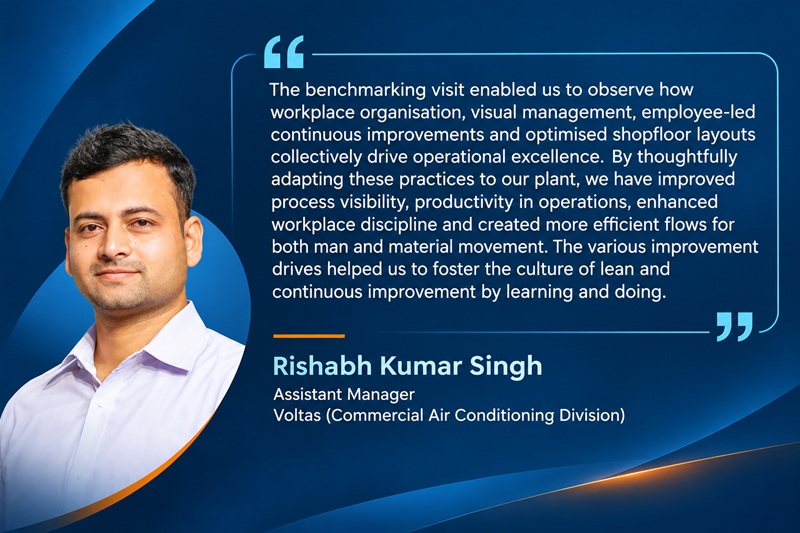
Participant Speak