
Published on August 07, 2026
Every year, AssessmentINSIGHTS is curated by Tata Business Excellence Group as a focused learning series to prepare assessors for the upcoming TBEM assessment cycle. While assessor certification programmes build foundational understanding of the TBEM 2.0 framework, AssessmentINSIGHTS helps assessors stay aligned with evolving assessment expectations, process enhancements, emerging business priorities and practical learnings from previous assessment cycles. Its objective is to help assessors begin their assessments with greater clarity, stronger context and a sharper ability to generate meaningful, evidence-based insights.
Building on previous editions, AssessmentINSIGHTS 2026 was designed around the evolving expectations of TBEM 2.0, the enhanced 2026 assessment process, the theme of Rigour with Compassion, and the growing need for assessors to connect business context, organisational resilience, cyber readiness, financial performance and future preparedness into a coherent assessment narrative.
What Did the Series Uncover?
Building Role Clarity and Assessment Leadership
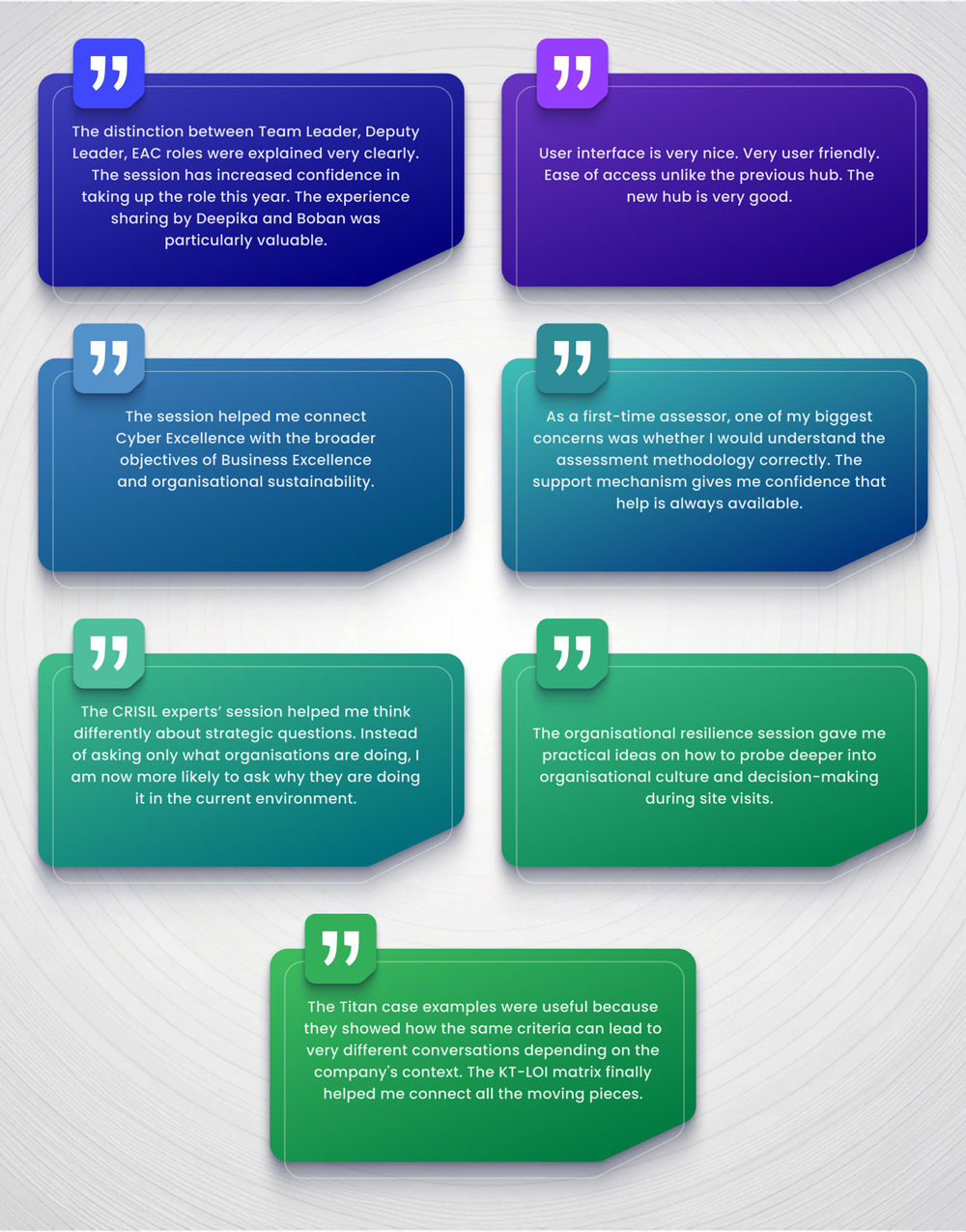
The series opened with an orientation for first-time Deputy Team Leaders and External Assessment Champions (EACs), covering assessment planning, stakeholder alignment, category consolidation, scoring objectivity and feedback quality. The session clarified the complementary nature for both these roles. It reinforced that effective assessment leadership requires creating structure, managing ambiguity and enabling assessment teams to perform effectively.
Enabling Assessors Through Assessment Hub 3.0
A live walkthrough introduced assessors to the new assessment hub. The Assessment Hub 3.0 is built on Microsoft Power Apps and integrated with SharePoint, Power BI, Dataverse and Power Automate. The session covered the workflow from KBFs and Key Themes through to Lines of Inquiry and category consolidation, concluding with a demonstration of Tata Sons' GenAI tool converting consolidated assessment data into insights. The key message: technology can accelerate assessments, but assessor judgement remains central to the outcome.
Strengthening the Cyber Excellence Lens
Cyber Excellence for TBEM assessors reinforced Cybersecurity as a business and leadership priority and the group’s focus area. Assessors were briefed on the cyber readiness requirements within TBEM 2.0 framework (Category 4.1d) and the Cyber Excellence framework, covering key areas such as asset management, access control, incident response, cloud security, data privacy, and OT/IoT security. The bigger shift: Cyber Maturity is now judged by whether these processes are reviewed, tested and improved over time, ensuring the organisations have a cybersecurity posture and are future ready.
Preparing First-Time Assessors for the Assessment Journey
The orientation for first-time assessors provided a refresher on the assessment inputs, outputs, roles, the buddy process, common assessment dilemmas and safety guidelines. Participants were encouraged to understand organisational context before drawing conclusions and actively contribute through Lines of Inquiry, strengths, opportunities for improvement (OFIs) and evidence-based discussions. The session was interactive and engaged the participants in discussing their dilemmas and concerns as they begin their assessment journey.
Making Financial Analysis More Insightful
The financial analyst orientation encouraged participants to move beyond ratio compilation and use financial information to understand the organisation’s value-creation story. The focus was on connecting revenue, cost, margin and cash-flow trends with strategy, resilience and long-term competitiveness. The role of Financial Analysts, and the value they provide in supporting the assessment teams to provide an objective was a key takeaway from the session.
Connecting Global Trends to Resilience and Growth
This session provided an outside-in perspective on geopolitical developments, inflationary pressures, supply-chain challenges, industry outlooks and the pace of digital adoption. Assessors were encouraged to evaluate organisational performance within the context of its operating environment and external realities. This session had external SMEs from CRISIL disseminating inputs on the Global macroeconomic situations in the current year.
Deepening the Focus on Organisational Resilience
The organisational resilience session encouraged assessors to look beyond policies and plans to understand how organisations anticipate disruptions, make decisions under uncertainty, recover from setbacks and continuously learn. Practical resilience domains, stakeholder mapping approaches and lines of inquiry helped strengthen resilience assessments. The session also covered Level 2 questions to enable assessors to evaluate organisational resilience across different industries.
Strengthening Inquiry Through the KT-Criteria-LOI Matrix
The concluding session focused on helping assessors use the KT-Criteria-LOI Matrix to develop more meaningful and nuanced questions during assessments. Assessors explored how to correlate multiple results, frame questions at intersections of Key Themes and criteria areas, and ensure broader inquiry coverage.
This represents an important shift for the 2026 cycle. The quality of assessments will increasingly depend on the quality of these inquiries. The KT-Criteria-LOI approach enables assessors to move from generic criteria coverage to more business-oriented, theme-led and evidence-seeking assessment conversations.
The Way Forward
The 2026 TBEM assessment cycle will require assessors to integrate business context, strategy, stakeholder expectations, technology, cyber readiness, financial performance, resilience and culture into a coherent assessment narrative. AssessmentINSIGHTS 2026 has helped prepare the assessor community through practical guidance, experience sharing and application-oriented learning.
As assessment teams begin their assignments, the focus will be on leveraging the Assessment Hub effectively, framing sharper Lines of Inquiry, strengthening evidence-based judgement alongside appreciative inquiry, integrating specialist perspectives, supporting first-time assessors and ensuring feedback remains relevant, actionable and business-oriented.
AssessmentINSIGHTS 2026 reinforces a simple belief: assessments create the greatest value when assessors are prepared not only to evaluate what is presented, but to understand what truly matters. With rigour in analysis and compassion in engagement, assessors are better positioned to support Tata companies in strengthening performance, resilience, cyber readiness and long-term excellence.
For more information, please write to Loveleen Mishra (loveleen.mishra@tata.com) or Madhu Chaithanya (mchaithanya@tata.com).